

TimberTech vs. Trex
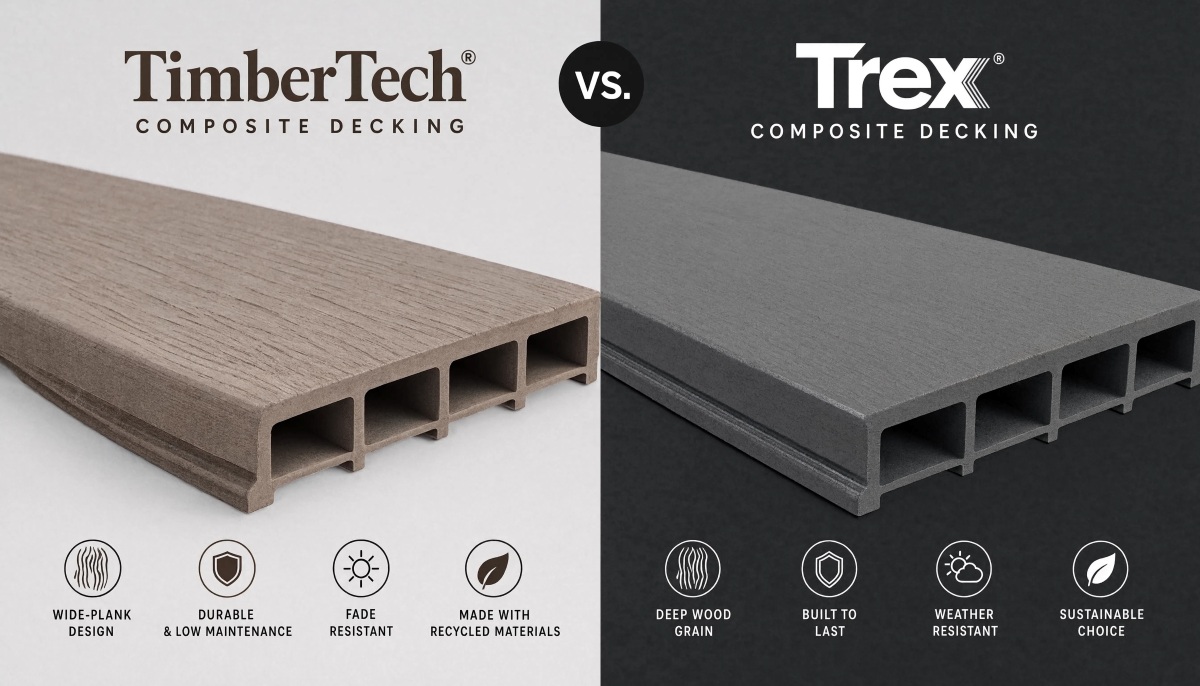
When homeowners start comparing composite decking options, TimberTech vs. Trex is often one of the first matchups they investigate. Both brands are well established in the decking industry; both provide alternatives to traditional wood, and both offer product lines designed to reduce routine maintenance. Still, choosing between them should involve more than comparing colors or looking at a few sample boards. The best decking system for your home depends on material construction, moisture resistance, surface performance, structural planning, installation details, maintenance expectations, and the overall design of your outdoor space.
For homeowners in Washington, those technical considerations become especially important. A deck regularly experiences rain, moisture, temperature changes, organic debris, and seasonal weather conditions. Selecting a quality decking product matters, but the way the entire deck is planned and assembled matters just as much.
At Evergreen Home Exteriors, we take a planning-first approach to remodeling projects. That means looking closely at materials, layout, sequencing, structural requirements, drainage, fastening systems, and finishing details before construction begins. If you are comparing TimberTech and Trex, understanding how the two systems differ can help you make a more informed long-term investment.
What Are TimberTech and Trex Decking?
TimberTech and Trex both manufacture low-maintenance decking products designed to recreate the appearance of wood without requiring the same routine staining, sealing, and refinishing associated with traditional lumber.
Although homeowners frequently refer to both brands simply as composite decking, their product catalogs can include boards with different material formulations and construction methods.
Broadly speaking, modern manufactured decking may use:
- Wood fibers blended with polymers
- Recycled plastic materials
- Protective polymer caps
- PVC-based construction
- Engineered surface textures
- Moisture-resistant cores
The specific product line you select matters. Comparing only the brand names can hide meaningful differences between individual collections.
A premium TimberTech board, for example, may perform differently from an entry-level TimberTech board. The same principle applies to Trex.
Instead of asking only, “Which brand is better?” homeowners should also ask, “Which specific product is best suited to my deck design, environment, budget, and performance expectations?”
TimberTech vs. Trex: Material Construction
One of the most important engineering considerations in the TimberTech vs. Trex comparison is board construction.
TimberTech
TimberTech offers multiple categories of manufactured decking, including composite and PVC-based options. That range can be useful when homeowners have specific performance goals.
Depending on the collection, TimberTech decking may feature engineered cores surrounded by protective surface materials. PVC options contain no wood fibers, which can be an attractive characteristic in applications where moisture exposure is a major concern.
Trex
Trex is widely associated with wood-plastic composite decking. Its boards combine recycled wood fibers and plastic materials into an engineered decking product.
Trex boards are generally capped with a protective exterior layer designed to improve resistance to stains, moisture, fading, and everyday wear.
Why Construction Matters
Board composition influences several characteristics, including:
- Moisture response
- Weight
- Heat retention
- Expansion and contraction
- Scratch resistance
- Fastening requirements
- Span requirements
- Long-term appearance
These differences are one reason professional planning is important. Deck framing, joist spacing, fastening methods, ventilation, and drainage should be compatible with the selected product rather than treated as interchangeable details.
Appearance and Wood-Look Realism
For many homeowners, appearance is one of the biggest deciding factors.
Both manufacturers offer boards designed to resemble natural hardwood, including products with varied grain patterns and multi-tonal coloration.
TimberTech frequently appeals to homeowners interested in sophisticated wood-like textures and premium visual detailing. Depending on the collection, boards may feature pronounced color variation intended to mimic the character of real wood.
Trex also provides a broad range of colors and wood-inspired finishes, from traditional brown tones to contemporary gray and earth-toned selections.
The better option ultimately comes down to the architecture of your home and your personal design goals.
Consider comparing samples next to:
- Exterior siding
- Trim
- Roofing
- Doors
- Outdoor furniture
- Railings
- Landscaping materials
- Stone or masonry features
A decking color that looks attractive in a showroom can appear different outdoors. Sunlight, cloud cover, moisture, shadows, and surrounding materials can significantly influence how the finished deck looks.
For that reason, evaluating full-size or representative samples at your home can be more useful than relying exclusively on photographs.
Moisture Resistance
Moisture management is an especially important consideration for Washington homes.
Both TimberTech and Trex manufacture decking designed to resist many of the moisture-related problems associated with conventional wood. Manufactured decking does not require the same periodic sealing schedule as natural wood, and properly selected products can provide excellent durability in wet climates.
However, decking boards are only one component of a moisture-conscious deck.
A well-planned deck should also account for:
- Proper board spacing
- Drainage
- Air circulation
- Flashing
- Ledger installation
- Water movement around the structure
- Properly protected framing
- Connection points
- Fastener compatibility
Even high-quality decking cannot compensate for poor structural detailing underneath.
This is why choosing a contractor based solely on installation price can create problems. The visible boards are important, but much of a deck’s long-term performance depends on details homeowners never see after construction is complete.
Maintenance Requirements
One major reason homeowners choose TimberTech or Trex is lower maintenance.
Traditional wood decks generally require periodic cleaning, staining, sealing, and refinishing to preserve their appearance and protect the lumber.
Manufactured decking eliminates much of that work.
Routine care typically focuses on cleaning the surface and removing debris rather than applying protective coatings every few years.
That can be especially valuable for homeowners who want to spend more time using their outdoor space and less time maintaining it.
Common maintenance tasks may include:
- Sweeping leaves and debris
- Washing dirt from the surface
- Cleaning spills promptly
- Keeping spaces between boards clear
- Removing organic buildup
- Following the manufacturer’s cleaning recommendations
Neither system should be considered completely maintenance-free. Every outdoor surface needs some care.
A more accurate description is low maintenance.
Scratch and Wear Resistance
Decking surfaces experience significant mechanical wear.
Chairs move across them. Dogs run over them. Grills are repositioned. Planters get dragged. Tools occasionally fall. Foot traffic concentrates around doors and stairs.
Scratch resistance therefore matters.
Both TimberTech and Trex manufacture products with protective surface layers designed for everyday residential use. However, scratch performance varies depending on the exact product collection and surface finish.
Homeowners with large dogs, heavy patio furniture, or high-traffic outdoor entertaining areas should discuss surface durability during product selection.
It is also smart to avoid dragging heavy furniture directly across any manufactured deck.
Furniture pads and careful handling can help preserve the finish regardless of brand.
Heat and Sun Exposure
All decking surfaces can become warm in direct sunlight.
The amount of heat a deck absorbs depends on multiple variables, including:
- Board color
- Material composition
- Sun exposure
- Air temperature
- Deck orientation
- Shading
- Local microclimate
Darker boards generally absorb more solar energy than lighter colors.
For a deck with extensive afternoon sun exposure, color selection becomes more than an aesthetic decision. It can influence comfort.
If barefoot use is important, compare physical samples under actual outdoor conditions whenever possible.
Deck orientation can also influence material selection. A shaded north-facing deck may behave differently from an exposed southwest-facing deck receiving intense afternoon sun.
Expansion, Contraction, and Installation Tolerances
Engineered decking expands and contracts as environmental conditions change.
The amount of movement depends on the material and product design.
This is where installation specifications become particularly important.
Correct installation may require carefully controlled:
- Board spacing
- End gaps
- Fastener placement
- Joist spacing
- Stair framing
- Blocking
- Edge support
Installers should follow the specifications for the exact decking line being used.
A deck is not simply a collection of boards screwed to framing. It is an interconnected system in which dimensions, fasteners, loads, moisture, and thermal movement need to work together.
Small installation errors can become visible over time.
Good planning minimizes those risks before the first board is installed.
Fastening Systems and Finished Appearance
Both TimberTech and Trex decking can often be installed using fastening systems designed to minimize visible screws across the deck surface.
Hidden fastening systems create a cleaner, more refined appearance and can provide consistent board spacing when installed properly.
There may still be areas where face fastening or specialized fasteners are required, such as:
- Stair treads
- Perimeter boards
- Picture-frame borders
- Certain angled sections
- Tight transitions
- Manufacturer-specified locations
Fastener selection should never be improvised.
Using compatible hardware helps protect the decking and contributes to long-term structural reliability.
Deck Framing Matters More Than Many Homeowners Realize
Homeowners understandably spend significant time choosing decking colors and railing styles, but the framing underneath deserves equal attention.
A beautiful deck built over poorly planned framing is still a poorly planned deck.
Important structural considerations can include:
- Joist spacing
- Beam placement
- Post locations
- Footings
- Ledger connections
- Lateral loads
- Stair construction
- Blocking
- Drainage
- Ventilation
- Hardware
Manufactured decking can also require different framing tolerances than traditional dimensional lumber.
For example, certain layouts, diagonal installations, or specialty patterns may require closer joist spacing or additional blocking.
This is why the deck design should be finalized before materials are ordered.
Railings and Design Integration
A new deck should look like an intentional extension of the home rather than a platform added afterward.
Both TimberTech and Trex offer decking systems that can be coordinated with railing components and complementary outdoor products.
However, homeowners are not necessarily limited to using every component from the same manufacturer.
A thoughtfully designed deck may combine compatible materials to achieve a particular architectural look.
Consider:
- Railing height
- Post spacing
- Sightlines
- Stair transitions
- Deck borders
- Lighting
- Fascia
- Skirting
- Privacy features
- Seating areas
The important factor is compatibility.
Connections, fastening systems, loads, and manufacturer requirements should be reviewed before combining components.
Cost: Is TimberTech or Trex More Affordable?
There is no universal answer because both manufacturers offer multiple product tiers.
Deck cost depends on significantly more than the price per board.
A complete estimate may involve:
- Decking
- Framing
- Footings
- Railings
- Stairs
- Fascia
- Fasteners
- Hardware
- Demolition
- Disposal
- Permits
- Labor
- Site access
- Design complexity
A simple rectangular deck installed close to grade will typically require less labor than a multilevel deck with stairs, custom borders, complex railings, and difficult access.
Premium decking can also increase material costs significantly compared with entry-level products.
Instead of evaluating only the board price, compare total installed project cost and expected long-term performance.
Warranty Considerations
Warranty coverage is another important comparison point.
TimberTech and Trex offer warranty protection on various product lines, but coverage can differ according to collection, application, installation method, and specific warranty terms.
Before purchasing, homeowners should review:
- Product warranty length
- Fade protection
- Stain protection
- Residential versus commercial coverage
- Installation requirements
- Transferability
- Exclusions
- Required maintenance
- Claim procedures
Do not assume every product sold under one brand carries identical warranty protection.
The warranty associated with the exact collection you are purchasing is what matters.
Professional installation can also help reduce the likelihood of avoidable issues caused by incorrect spacing, fastening, or structural preparation.
TimberTech vs. Trex for Washington Homes
Washington’s climate makes moisture management especially important.
Rainfall, wet leaves, shaded areas, seasonal debris, and long periods of damp weather can challenge outdoor structures.
Both brands can be strong options when the selected product is appropriate for the application, and the deck is built correctly.
For Washington homeowners, we recommend paying particularly close attention to:
- Drainage around and beneath the deck
- Ventilation
- Flashing details
- Ledger protection
- Framing condition
- Fastener corrosion resistance
- Organic debris accumulation
- Shaded areas that dry slowly
Deck longevity is ultimately a systems problem.
Selecting a premium surface material is helpful, but a durable deck requires every layer of the assembly to function correctly.
Which Brand Has More Design Flexibility?
Both manufacturers provide enough design options for most residential deck projects.
The deciding factor may come down to the particular aesthetic you want.
TimberTech may appeal to homeowners prioritizing premium wood-inspired visuals or certain PVC decking options.
Trex may appeal to homeowners looking for familiar composite construction with numerous established product collections.
Instead of choosing a brand first, start with your performance requirements.
Ask yourself:
- How much direct sunlight does the deck receive?
- How much moisture exposure is expected?
- Do we have pets?
- Will furniture move frequently?
- What color works with the house?
- Do we want wide stairs?
- Will the deck include multiple levels?
- Do we want picture-frame borders?
- What railing style fits the architecture?
- How much maintenance are we willing to perform?
Once those requirements are clear, comparing products becomes considerably easier.
Sustainability and Material Efficiency
Homeowners increasingly consider environmental impact when selecting remodeling materials.
Manufactured decking can incorporate recycled content and may reduce the need for staining and refinishing products over the deck’s service life.
Long-term durability is also relevant to sustainability.
A product that performs reliably for decades can reduce the frequency with which materials need to be removed and replaced.
However, sustainability should be evaluated alongside practical engineering considerations.
A material that is theoretically durable will only realize that potential if it is installed properly.
Proper structural design, ventilation, drainage, fastening, and maintenance can contribute substantially to maximizing the useful life of the deck.
Common Mistakes When Choosing Composite Decking
The TimberTech vs. Trex decision can become unnecessarily complicated when homeowners focus on the wrong factors.
Choosing Based Only on Color
Color matters, but performance requirements should come first.
Comparing Brands Instead of Product Lines
Both manufacturers have different collections. Compare equivalent products rather than treating every board from a brand as identical.
Ignoring Framing Requirements
The decking surface cannot compensate for poorly designed framing.
Selecting the Lowest Bid Automatically
Two deck estimates may include very different scopes, materials, structural details, or installation methods.
Forgetting About Railings and Stairs
These components can have a significant impact on design, safety, budget, and construction complexity.
Overlooking Water Management
In wet climates, drainage and flashing deserve serious attention.
How to Evaluate Decking Samples
Physical samples can make your decision easier.
When reviewing TimberTech and Trex samples, do more than compare them under indoor lighting.
Take them outdoors.
Look at them during different times of day and next to your home’s exterior.
Pay attention to:
- Grain pattern
- Color variation
- Surface texture
- Sheen
- Heat
- Visual compatibility
- Edge appearance
You may find that a color you loved online looks dramatically different next to your siding.
Conversely, a color you initially overlooked may fit perfectly once you see it in context.
Think About the Entire Deck System
The best deck projects start with the complete system rather than the surface material alone.
A successful project requires coordination between design, engineering, materials, and construction sequencing.
That may include planning the relationship between:
- Footings
- Posts
- Beams
- Joists
- Decking
- Railings
- Stairs
- Flashing
- Fascia
- Drainage
- Lighting
When each component is considered early, installation becomes more predictable, and the finished deck looks more intentional.
This planning-first philosophy is particularly valuable on remodeling projects, where the existing home can introduce conditions that are not present in new construction.
TimberTech vs. Trex: Which Should You Choose?
There is no single winner for every homeowner.
Both TimberTech and Trex manufacture highly capable decking products. The better choice depends on the particular collection, your project conditions, aesthetic priorities, budget, and long-term expectations.
TimberTech may deserve closer consideration if you are particularly interested in its premium aesthetic options or PVC decking products.
Trex may be attractive if you want a widely recognized composite decking system with numerous colors and product tiers.
For many homeowners, the best way to decide is to compare equivalent product lines side by side and then evaluate how each option fits the engineering requirements of the deck.
The contractor should also consider how the selected product affects framing, fasteners, stairs, borders, transitions, and sequencing.
That is where a planning-first process becomes valuable.
Frequently Asked Questions
Is TimberTech better than Trex?
Neither brand is universally better. Both offer multiple product lines with different construction, appearance, pricing, and performance characteristics. The best choice depends on your specific project.
Is TimberTech more expensive than Trex?
It can be, depending on which collections you compare. Both manufacturers have multiple price tiers, so total project cost should be evaluated using comparable products and installation scopes.
Which decking is better for rainy climates?
Both manufacturers offer products suitable for wet environments. Proper flashing, drainage, ventilation, framing, and installation remain critical regardless of which decking brand you choose.
Does composite decking need to be sealed?
Manufactured composite and PVC decking generally does not require the routine staining and sealing associated with traditional wood decking. Follow the maintenance instructions provided for your specific product.
Does composite decking get hot?
Yes. Any decking material can become warm in direct sunlight. Darker colors generally absorb more heat, so homeowners concerned about surface temperature should compare samples in actual sunlight.
Can TimberTech or Trex be installed over an existing deck frame?
Sometimes. The existing framing must first be evaluated for condition, spacing, structural adequacy, levelness, moisture damage, and compatibility with the new decking system.
How long does composite decking last?
Service life depends on the product, environment, installation quality, structural conditions, and maintenance. Selecting a high-quality board is only one part of creating a long-lasting deck.
Which brand looks more like real wood?
Both TimberTech and Trex offer realistic wood-inspired options. Appearance is subjective, so comparing physical samples is usually the best approach.
Are hidden fasteners better than visible screws?
Hidden fasteners can provide a cleaner appearance and consistent spacing when used in approved applications. However, some deck details may still require face fasteners or specialized hardware.
Should I replace the framing when installing new composite decking?
Not automatically. Existing framing should be inspected carefully. Damaged, undersized, poorly spaced, or deteriorated framing may need repair or replacement before new decking is installed.
Build Your Deck With a Planning-First Approach
Choosing between TimberTech and Trex is important, but choosing the decking board is only one decision within a much larger project. Framing, drainage, flashing, fasteners, railings, stairs, layout, transitions, and construction sequencing all influence how your deck looks and performs years after installation.
At Evergreen Home Exteriors, we’re a Washington remodeling contractor focused on planning-first project delivery. We emphasize clear scope, clean sequencing, thoughtful material selection, and craftsmanship that looks great up close while performing long-term.
If you are considering a new deck or replacing an aging one, our team can help you evaluate your options, understand the trade-offs, and develop a plan that fits your home.
Schedule your FREE, no-pressure consultation with us today and start planning an outdoor space designed for lasting performance.